Highly Skilled
Individuals Rules
Malta has introduced a new consolidated tax framework for highly skilled international employees. The Tax Treatment of Highly Skilled Individuals Rules, 2026 replace several previous sector-specific expatriate tax programmes such as the ‘Qualified Earners’ Scheme’ with a single regime offering a preferential 15% flat tax rate on qualifying employment income of at least
The Rules apply from 1 January 2026 and are intended to support Malta’s ability to attract senior and specialist talent in regulated and high-value sectors.
KEY
BENEFITS
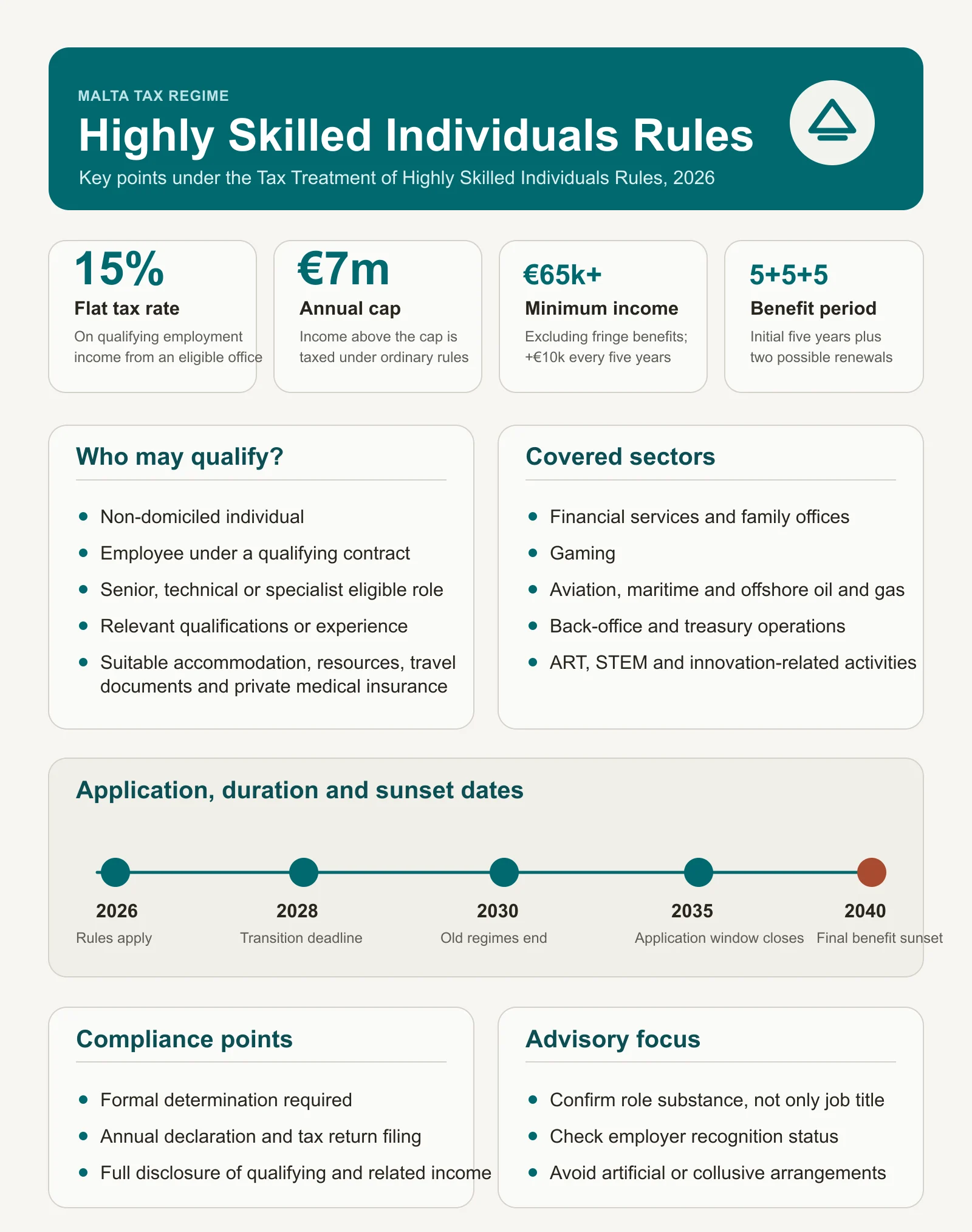
Eligible individuals may opt to be taxed at a 15% flat rate on qualifying employment income derived from an eligible office in Malta, up to €7 million per year. Income above this cap is taxed under Malta’s ordinary income tax rules.
The 15% rate applies only to qualifying employment income. Other income remains subject to the ordinary Maltese tax rules applicable to the individual’s circumstances.
WHO MAY QUALIFY?
An individual may qualify where they:
- Are not domiciled in Malta.
- Are employed under a qualifying contract of employment.
- Hold an eligible senior, technical or specialist role.
- Work in a sector regulated, licensed or recognised by a competent Maltese authority.
- Earn at least €65,000 per year, excluding fringe benefits.
- Hold relevant professional qualifications or comparable professional experience.
- Have stable resources, suitable accommodation, valid travel documentation and private medical insurance.
- Fully declare qualifying employment income and related-party income connected to the qualifying role.
The minimum income threshold increases by €10,000 every five years.
COVERED SECTORS
The Rules apply to eligible roles in sectors recognised by competent authorities such as the:
- Malta Financial Services Authority; and
- Malta Gaming Authority;
- Transport Malta, Malta Enterprise;
- Office of the Chief Medical Officer.
Relevant sectors include:
- Financial services
- Gaming
- Aviation
- Maritime activities
- Offshore oil and gas ancillary services
- Family offices, back-office and treasury operations
- Assisted reproductive technology
- STEM and innovation-related activities
Eligibility is role specific. A job title alone is not sufficient; the role, duties, employer status and applicable competent authority must all be considered.
The Legal Notice lists eligible roles such as CEO, CFO, COO, CTO, chief/head risk officer, compliance and AML head, portfolio manager, chief investment officer, senior trader, aviation accountable manager, maritime technical manager, embryologist, responsible person, odds compiler specialist, data scientist, cybersecurity analyst, AI specialist, engineers, statisticians and operations research analysts.
The guidelines clarify that Malta Enterprise may issue determinations for manufacturing, software development, industrial services linked to manufacturing, health, biotechnology, pharmaceuticals and life sciences, and other innovative economic activities where the employer is not regulated by another competent authority.
Application
process
Applications are submitted to the relevant competent authority. The authority reviews the application and issues a formal determination of eligibility or refusal.
Once a formal determination is issued, the individual may exercise the 15% tax option through the required annual declaration and tax return filing. The option is valid only where the relevant income is fully and correctly declared.
Duration
The benefit applies for an initial period of five years. Subject to continued eligibility, it may be renewed for two further five-year periods, giving a potential total benefit period of up to 15 years.
Applications may be submitted between 1 January 2026 and 31 December 2035. No applications may be accepted after 31 December 2036, and no benefit may apply to income earned after 31 December 2040.
TRANSITION FROM
PREVIOUS SCHEMES
The new Rules replace the previous:
- Highly Qualified Persons Rules
- Qualifying Employment in Innovation and Creativity Rules
- Qualifying Employment in Aviation Rules
- Qualifying Employment in Maritime Activities and Offshore Oil and Gas Servicing Rules
- Senior Employees of Family Offices, Back Offices and Treasury Management Operations Rules
Individuals benefiting from these regimes as at 31 December 2025 may apply to transition to the new framework by 31 December 2028. No further benefit under the outgoing regimes may be availed of after year of assessment 2030.
PRACTICAL
CONSIDERATIONS
Employers and individuals should confirm eligibility before relying on the 15% rate. In practice, this means reviewing:
- The employer’s regulatory or recognised status.
- The employee’s role, duties and level of seniority or technical expertise.
- The employment contract and remuneration package.
- The individual’s domicile, residence and immigration position.
- Annual declaration, tax return and document-retention obligations.
- Any related-party payments or arrangements connected with the role.
ANTI ABUSE RULES
The Rules also contain anti-abuse provisions aimed at artificial arrangements, including structures designed to bring non-qualifying employment within the preferential regime.
Overview
- New unified regime: The Tax Treatment of Highly Skilled Individuals Rules, 2026 replace Malta’s previous Highly Qualified Persons and sector-specific expatriate tax regimes.
- Effective date: The Rules apply from 1 January 2026.
- Main tax benefit: Eligible individuals may benefit from a 15% flat tax rate on qualifying employment income.
- Income cap: The 15% rate applies to qualifying employment income up to €7 million per year.
- Excess income: Employment income above €7 million is taxed under Malta’s ordinary income tax rules.
- Minimum income requirement: The individual must earn at least €65,000 per year, excluding fringe benefits.
- Threshold increase: The €65,000 minimum increases by €10,000 every five years.
- Eligible individual: The applicant must be non-domiciled in Malta.
- Qualifying employment: The individual must be employed under a qualifying contract of employment and protected as an employee under Maltese law.
- Eligible role: The role must be a senior, technical or specialist position recognised by the relevant competent authority.
- Professional qualifications: The individual must hold relevant qualifications or have comparable professional experience.
- Covered sectors: The regime covers eligible roles in financial services, gaming, aviation, maritime, offshore oil and gas services, family offices, treasury/back-office operations, assisted reproductive technology, STEM and innovation.
- Competent authorities: Relevant authorities include the MFSA, Malta Gaming Authority, Transport Malta, Malta Enterprise and the Office of the Chief Medical Officer.
- Application requirement: A formal eligibility determination must be obtained from the relevant competent authority.
- Annual compliance: The individual must exercise the option through the required annual declaration and tax return filing.
- Full disclosure: Qualifying employment income and related-party income connected with the role must be fully and correctly declared.
- Benefit period: The benefit applies for an initial five-year period.
- Extensions: The benefit may be extended for two further five-year periods, subject to continued eligibility.
- Maximum period: The total potential benefit period is up to 15 years.
- Final sunset date: No benefit may apply to income earned after 31 December 2040.
- Application window: Applications may be submitted from 1 January 2026 to 31 December 2035.
- Final acceptance deadline: No applications may be accepted after 31 December 2036.
- Transition from old regimes: Existing beneficiaries under previous regimes may apply to transition by 31 December 2028.
- End of old regimes: No further benefit under the outgoing regimes may be availed of after year of assessment 2030.
- Anti-abuse rules: Artificial arrangements, collusive structures and undeclared related-party benefits may lead to denial or clawback of the tax benefit.
How Acumum
can assist?
Acumum can assist employers and individuals with:
- Initial eligibility assessments
- Review of employment contracts, role descriptions and remuneration structures
- Coordination of competent authority applications
- Transition planning for individuals under previous regimes
- Ongoing compliance support and annual review
- Wider Malta tax, immigration and corporate structuring considerations
FAQ
SECTION
What is the Malta Highly Skilled Individuals regime?
It is a Maltese tax regime that allows eligible senior and specialist employees to benefit from a 15% flat tax rate on qualifying employment income.
Who is the Malta highly skilled individual regime for?
It is aimed at non-domiciled individuals employed in Malta in eligible senior, technical or specialist roles within recognised sectors.
What tax rate applies?
Qualifying employment income may be taxed at a flat rate of 15%, subject to the applicable cap and conditions.
What is the minimum salary requirement?
The minimum annual employment income is €65,000, excluding fringe benefits. This threshold increases by €10,000 every five years.
Does the regime replace the Highly Qualified Persons Rules?
Yes. The new rules replace the Highly Qualified Persons Rules and several other sector-specific expatriate tax regimes.
How long does the benefit last?
The benefit is available for an initial five-year period, with the possibility of two further five-year extensions, subject to continued eligibility.
Can existing beneficiaries transition?
Yes. Existing beneficiaries under previous regimes may apply to transition by 31 December 2028, provided they meet the relevant conditions.